Penguin Patrol: DZS Studies Penguin Health in the Falkland Islands
March 27, 2025
Articles
By Sarah Culton, Communications Manager
For Dr. Ann Duncan, associate vice president of life sciences for the Detroit Zoological Society (DZS), the perfect day ends watching the sunset over the Atlantic Ocean as sea lions swim below and penguins waddle along the shore.
But this isn’t a vacation. It’s the reward after a long, grueling day of fieldwork in harsh, windy conditions — all in the name of conservation.
“I’m not one to lay on a chair reading a book,” Duncan says with a laugh. “I love being out there and making a difference.”
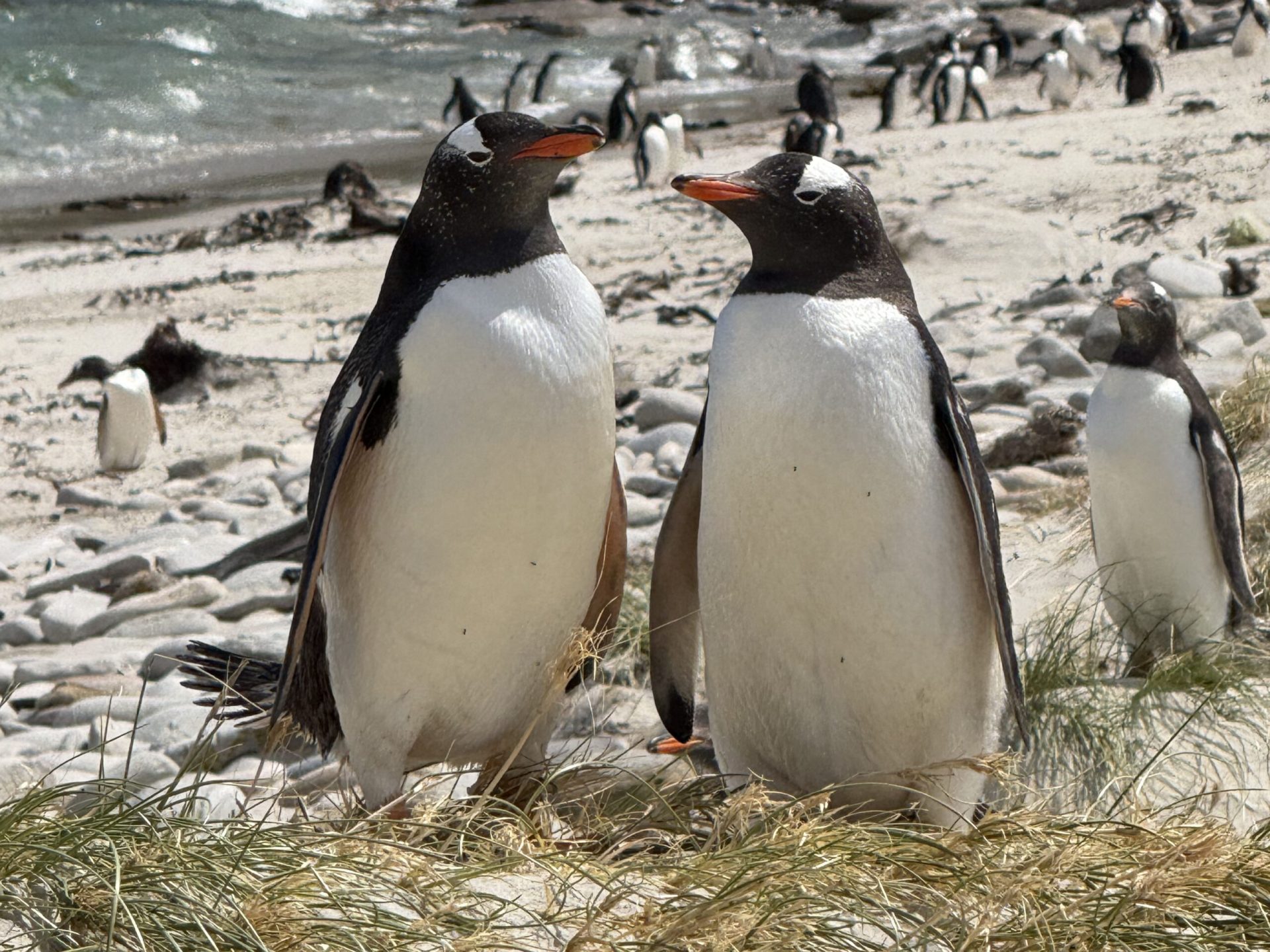
Duncan, along with a team that included a veterinary technician and two animal care specialists, recently traveled to the Falkland Islands, off the coast of Argentina, to conduct groundbreaking field research on wild rockhopper and gentoo penguins.
Their mission: to assess the impacts of infectious disease, pollution and tourism on penguins living in the wild.
This research — the most comprehensive study of animal health and well-being
in DZS history — is a crucial step in advancing the conservation of penguins everywhere. The study began in 2018 and is a collaboration with Falklands Conservation (FC), an organization dedicated to monitoring and protecting the region’s wildlife. By gathering biological samples and health data from penguin colonies living on the Islands, researchers hope to develop informed, science-based conservation strategies to safeguard seabird species.
A UNIQUE PARTNERSHIP
The DZS’s partnership with FC started long before this study took shape. Combining the DZS’s expertise in animal health and care with FC’s on-the-ground research, this partnership helps penguins and seabirds in the region.
From 2016 to 2018, the DZS and FC conducted expeditions to several remote islands. Using drones, they gathered population data and documented habitat conditions. Building on this success, the two organizations sought to expand their partnership. FC invited the DZS to develop a project to investigate what might be contributing to a decline in the number of penguins in the region.
This led to an ongoing, multi-year study and three field expeditions to the Falkland Islands, where DZS veterinary and animal care specialists joined FC researchers to collect critical health data from some of the world’s largest populations of gentoo and rockhopper penguins. It was determined that the team would travel during the penguin breeding season, as it is one of the few times penguins are routinely out of the water and able to be researched on land.
“The goal of this study is to collect data to help understand the factors that influence penguins in the Falkland Islands,” Duncan says. “Penguins and other seabirds living in polar areas are among the species most impacted by climate change, and it’s important to understand the factors that are impacting their health and viability. Studying the health of penguins helps us understand the health of the entire ecosystem.”
A SPECIAL SET OF SKILLS
A tiny airplane, a Range Rover and a good pair of hiking boots. These are just a few of the essential tools needed to make this study successful.
“Traveling to the Falklands isn’t easy. It’s a big effort that takes multiple days and flights,” says Lindsay Ireland, bird supervisor, who has twice traveled with the DZS to the Falklands as part of this study. “You have to carry a lot of stuff with you; you have to go on these long, bumpy car rides over uneven terrain that you don’t know if you will get stuck in. You have to hold on very tight and hope there are no surprises in front of you.”
Though all the equipment the team brings — including a large liquid nitrogen tank to store bio samples — is useful, the biggest value the DZS team brings to this project is expertise in animal health and well-being. The study requires researchers to hold the penguins to collect blood samples, feather clippings and saliva swabs. As the DZS team is experienced in holding penguins in human care for veterinary exams and routine care, they are able to work with wild penguins quickly and efficiently to ensure no harm comes to either animal or researcher.
“We know how to care for penguins in ways that are less stressful for them,” Ireland says. “Some of the tools we use, like a field scale that a penguin dangles from, may look strange, but everything we do is to minimize the impact on the penguins. After we were done, they would go right back to their nests to feed their chicks.”
After collecting samples in the field all day, the team spends up to four hours each night organizing, processing samples, making slides and labeling to prepare the materials to return to the Detroit Zoo for further study. The team looks for the presence of health issues, toxicity, exposure to infectious diseases and any other abnormalities in the samples.
“These are long days,” Duncan says. “During our last trip, we collected and processed samples from 60 penguins. From the start of the project, we have collected samples from 233 rockhoppers and gentoos.”
Collectively, the team has decades of animal care expertise and fieldwork experience to help them, but working in the Falklands still presents some unique challenges. Not only do the zookeepers and veterinarians have to use different equipment than they are accustomed to, they must adapt to the weather and environment of the Falklands. But to Duncan, these challenges make fieldwork all the more fun.
“When you are in the Falklands, it is always, always, always windy and often rainy,” she says. “The rain makes it difficult to write notes, and if you let go of your papers for even a second, you might see them blowing away down the beach.”
Despite the challenges, Duncan and Ireland agree they wouldn’t have it any other way.
“I’ve spent more time on this project than any other at the Zoo. It holds a special place in my heart,” Duncan says. “Throughout my career, I’ve had lots of opportunities to help penguins in zoos live longer, healthier lives, but using those skills to help penguins in the wild is extra rewarding.”
“It’s very rewarding as a zookeeper to participate in conservation projects because this is ultimately our goal. We want to protect animals in their natural habitats,” Ireland adds. “Even though the travel down there can prove to be difficult at times, we get this incredible experience and have met some great friends through Falklands Conservation.”
LOOKING TO THE FUTURE
Now that all the samples have been collected, a waiting game begins — for the general public, at least. Though it will take time before the study results are published, Duncan and the team are hard at work processing and analyzing samples and writing up their findings.
Duncan believes it will be worth the wait. She says the study has already helped implement biosecurity measures to protect birds in the region from diseases such as Highly Pathogenic Avian Influenza, also known as bird flu.
“We have put a lot of time and resources into this project and are hoping we will use the information we learn to inform policies in the Falklands,” she says. “With the findings of this study, we might be able to understand the diseases that impact these bird populations in the future and how we can mitigate the risks. This could look like increased biosecurity measures or policies and regulations around petroleum and other industries. By protecting penguins, we also can protect people and the environment.”
DZS Director of Conservation Dr. David Dimitrie also believes in the program and cannot wait to see the study results.
“This study really demonstrates the value of an organization like the DZS being able to provide expertise to a valued conservation partner,” he says. “Our vet team provides top-notch care, and our animal care team provides invaluable expertise in handling animals. This is just one way we are using our unique skills to fulfill our conservation commitment. We are excited to continue to be a conservation leader and to explore more collaboration opportunities with partners like Falklands Conservation.”
No matter the outcomes of the study or where the future takes Duncan, Dimitrie and the rest of the DZS team — even if it’s far from a sunset-lit beach — the DZS will remain committed to ensuring a healthier future for penguins in the Falkland Islands and beyond.
“Conservation is at the heart of everything we do,” Duncan says. “We are committed to protecting animals and nature — and that is worth all the work that goes into a project like this.”
Be a champion for change and make a charitable gift to the DZS for conservation programs. Your donation will support important research studies on the well-being of animals like the rockhopper and gentoo penguins in the Falkland Islands. Make your best gift today at dzoo.org/penguinconservation25 or contact Andrea Richards in the development office at (248) 336-5729 for more information.