Canine Conservation: Zoo-Park Partnership Helping Wolves on Isle Royale
July 18, 2024
Animals
By Sarah Culton, communications manager
After walking up to 10 miles a day for a week through Isle Royale National Park in northern Michigan, Dr. Ann Duncan came home with her feet blistered and her body exhausted.
“I slept for 12 hours the day after I got back. I couldn’t believe it,” Duncan laughs, sitting in her office at the Detroit Zoo, where she serves as associate vice president of life sciences. “I’ve been back for a few days and still haven’t fully recovered.”
The miles Duncan put on her hiking shoes were worth it, she says, as they supported conservation research that could help wolves on Isle Royale thrive.
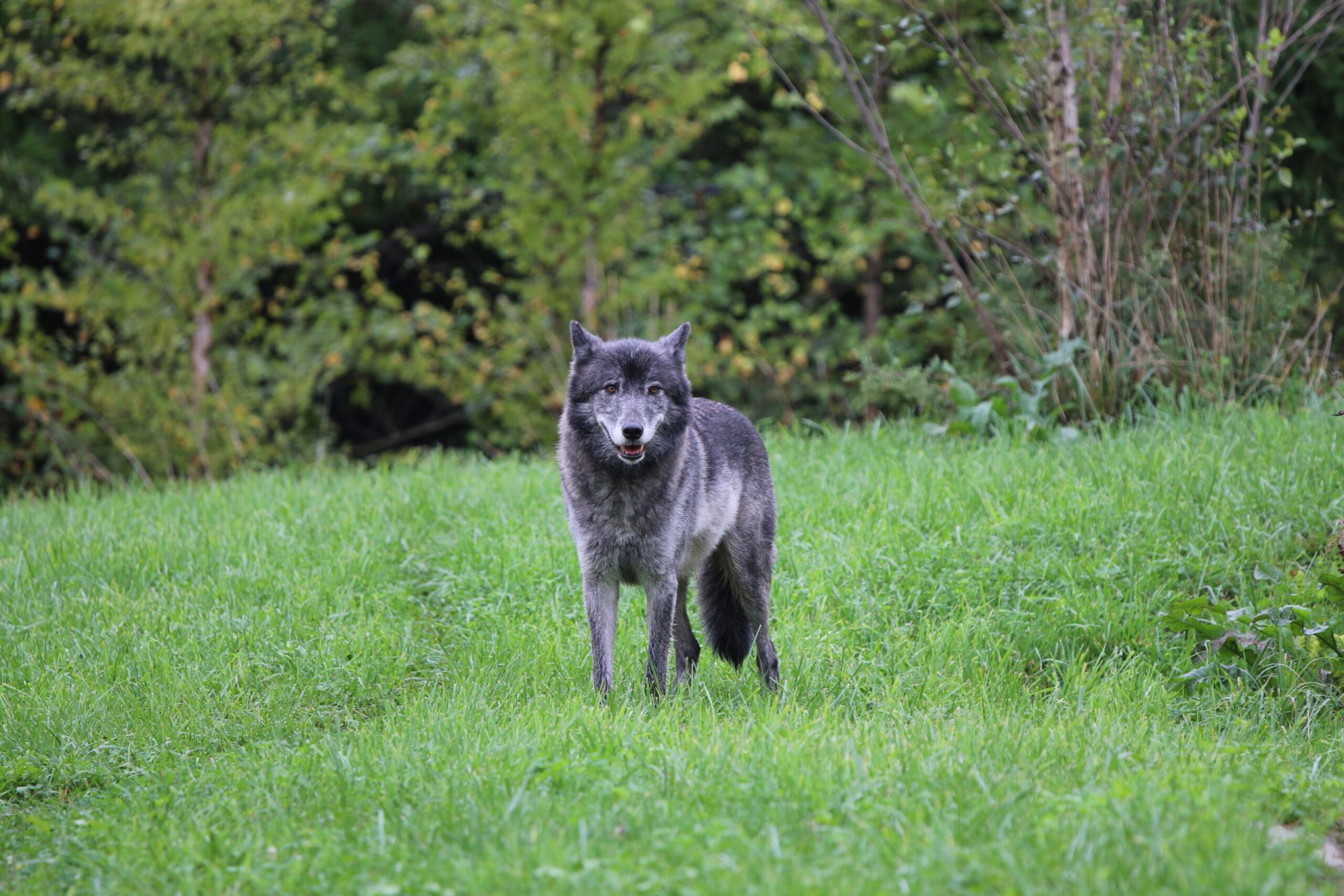
Duncan’s visit was part of a Zoo-Park Partnership (ZPP) for America’s Keystone Wildlife with Isle Royale National Park to support the recovery of wolves and their relationship with moose on this island in the middle of Lake Superior. With assistance from university researchers, trail cameras, installed strategically throughout the island, help the National Park Service document wolf and moose interactions, document the numbers of animals and allow for estimates of abundance for other wildlife species on the island. The partnership also tracks the genetic health of the wolf population, as well as other statistics.
This work is vital as Isle Royale’s wildlife is coming back from the brink of a crisis. In 2018, it was reported that the island’s wolf population had been reduced to one pair of closely related canines. In response, the National Park Service, along with states, tribal and Canadian partners, worked to reintroduce wolves from surrounding areas to the island. Their efforts were successful, leading to an increase in reproduction over two years. But there was still more work to be done.
In recent years, the DZS has advanced its commitment to the ZPP by helping coordinate onsite meetings at the Detroit Zoo and on Isle Royale.
These meetings revealed shared goals and offered opportunities for continued collaboration – including a genome project supported by the DZS that studies the impact of overall wolf population health.
During her most recent visit to the island, Duncan assisted with the project at large and helped collect samples important to ongoing research. Her work will positively contribute to the conservation of wild gray wolves.
“Isle Royale is truly a magical place, and it feels wonderful that I can help contribute to conservation there,” she says. “For me, the success of this project would be finding evidence that the wolf population is maintaining good genetic diversity and is as healthy as it can be for a wild population.”
To the DZS’s conservation director, Dr. David Dimitrie, the ZPP is helping conservationists near and far better understand Isle Royale and how to preserve essential ecosystems.
“It’s awesome to be a part of this project at Michigan’s national park,” he says. “The wolf population is an important part of the ecosystem up there, and this work is helping us all understand the biology of this species and the island’s ecosystem. It’s important to understand how factors like climate change are having an impact and what we can do to ensure Isle Royale thrives.”
Both Duncan and Dimitrie believe the program is having a positive impact and are excited to share its successes with the community. Knowing that the average Detroit Zoo guest can’t make it to Isle Royale to participate in conservation fieldwork, the doctors said community members can still support the conservation of their favorite canines by seeking out more information and supporting the DZS and other like-minded organizations.
“Gray wolves are such beautiful animals, but they are often misunderstood,” Duncan says. “Learning more about them and understanding that they deserve our protection is a great place to start.”