The golden years
June 4, 2026
Articles
The golden years

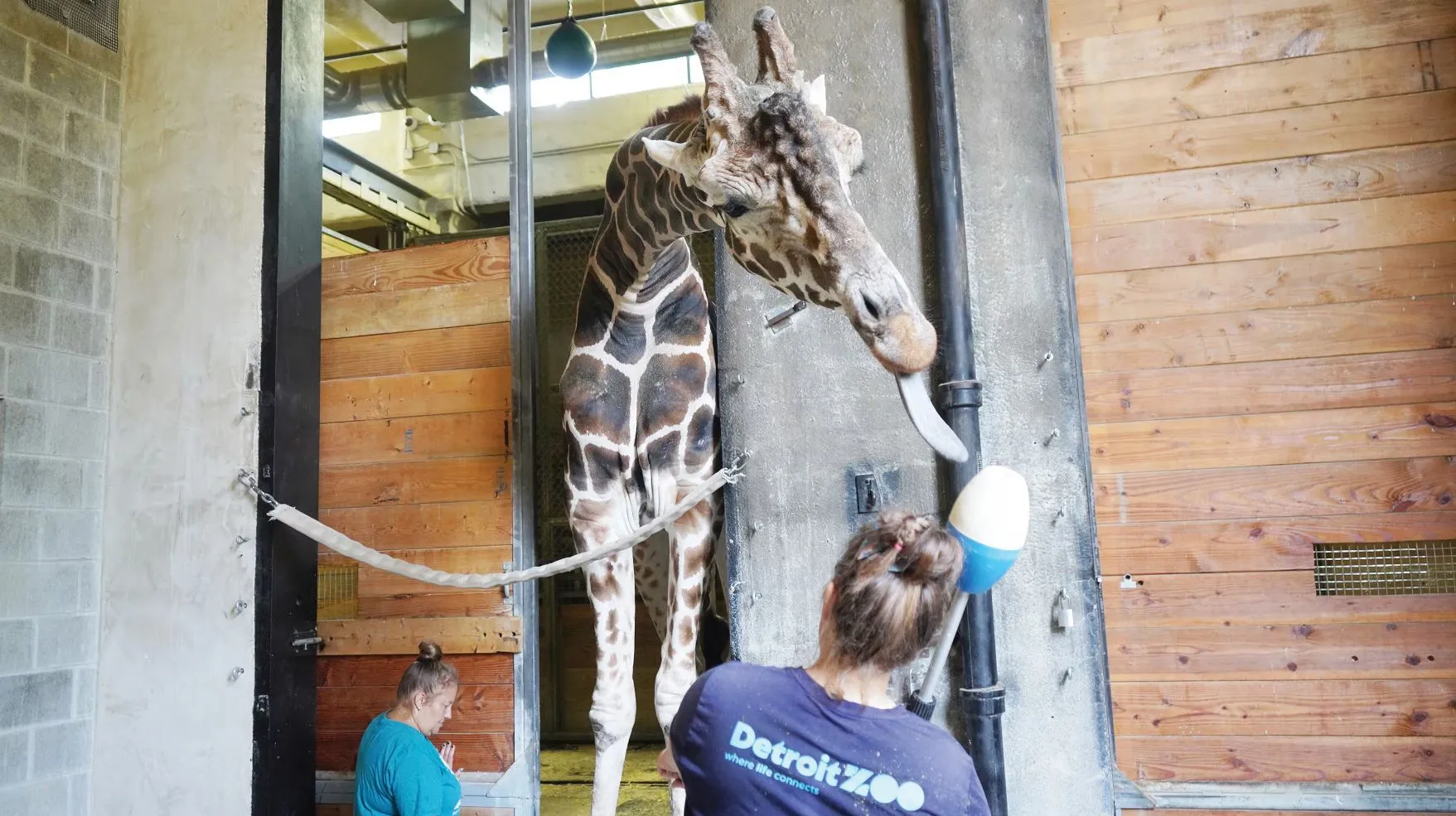
Share Zookeeper Stephanie Rasmusivich holds a pole that giraffe Jabari touches with his tongue. Zookeeper Stephanie Rasmusivich hosts a wellness session with Jabari, allowing the animal care team to study his hooves. (Detroit Zoological Society)
By Sarah Culton, Detroit Zoological Society Communications Manager September 22, 2025 05:01 AM EDT
Jabari the giraffe’s wellness routine is a little different — and more complex — than your average trip to the salon or spa.
It starts with months and years of trust. Jabari must first build a good relationship with his caretakers before stepping into his indoor habitat, touching his nose to a training stick and lifting a hoof onto a raised platform. There, a team member carefully examines and cleans the hoof. Once the checkup is complete, Jabari lowers his nearly 18-foot-tall head for a well-earned treat: a crunchy rye cracker.
This routine isn’t just about keeping his hooves tidy. It’s an essential part of his ongoing medical care to ensure this senior giraffe stays comfortable and healthy well into his golden years. At 17 years old, Jabari is considered a senior in the giraffe world. He’s one of several aging animals the Detroit Zoo team cares for, with zookeepers, animal welfare scientists and veterinarians working hand-in-hand to help each one age with dignity and comfort.
“Having animals in human care is a huge responsibility, and we have a moral obligation to ensure they have the highest quality of life for as long as possible,” says Brian Manfre, curator of mammals. “A lot of guests don’t know that behind-the-scenes, there is a tremendous effort that goes into keeping these animals comfortable and prolonging their good life as long as we can.”

In Jabari’s case, that effort looks like a lot of wellness training with his zookeeper team to make essential veterinary care possible. The wellness sessions in which he presents his hooves for inspection allow him to take an active role in his medical care, making blood draws, x-rays, radiographs and trimming possible. To Manfre and Chief Life Sciences Officer Mike Murray, the strides made with Jabari’s elder care are nothing short of extraordinary.
“These are huge animals — 18 feet tall sometimes and more than 2,000 pounds,” Murray says. “They spend so much time on their feet, so it’s critical to take care of their feet. The time and care the team puts into training to ensure we can keep the feet healthy demonstrates our leadership in giraffe care. It’s a testament to the strong collaboration between animal care, veterinary care and animal welfare science, and I’m very proud of the team.”
Jabari isn’t the only animal receiving extra attention to help him thrive in his golden years. Thanks to dedicated care, improved technology and advances in veterinary science, animals at the Zoo are living longer than they would in the wild — and longer than ever before in the Zoo’s history. That longevity brings new challenges, as more residents require specialized care and close monitoring with age.
Trixi the chimpanzee manages diabetes with a tailored treatment plan. Suren the camel takes medication to ease arthritis pain. Knick-Knack the miniature donkey and Clover the eland receive regular hoof checks to keep them moving comfortably.

Then there’s Kaska, a 15-year-old wolf. In his later years, joint problems have made mobility more difficult. During his life, Kaska has undergone regular health exams, during which veterinarians draw blood to monitor his overall health and organ function and provide targeted treatments to improve his quality of life. He even receives cutting-edge stem cell therapy, which helps reduce inflammation, lower the risk of infection and keep his joints moving smoothly.
Innovative medical treatments like these are essential to ensure animals thrive at every age, says Dr. Ann Duncan, associate vice president of life sciences.
For many senior animals, medication and pain management are essential to keeping them comfortable — much like the regimens many humans follow as they age. But treatment isn’t limited to medicine alone. Sometimes, it can be as simple as ensuring the camels continue to move and walk to retain mobility. Or there are more inventive treatments. Recently, to help an elderly snake, the Zoo team brought in a specialist to perform acupuncture with promising results.

“We do everything we can to keep the animals healthy and comfortable, which can mean combining a variety of medications and interventions,” Duncan says. “Every treatment plan is individualized and tailored to the specific needs of each animal. A lot of these animals live for a very long time, and they are very precious to us and to our guests. We owe it to the animals to do our best to ensure they are healthy throughout their entire lives, provide everything they need to thrive and make informed decisions for their health. And that can be hard.”
When an animal ages or develops a chronic health condition, the Zoo’s veterinary, welfare and care teams convene regularly to assess the animal’s quality of life. Using detailed data, they evaluate factors such as mobility, social interactions, behavior and how the animal engages with their habitat.
Despite countless wellness sessions, medical treatments and expert attention, there comes a point when the focus shifts to end-of-life care. These moments are never easy for the staff who have built deep bonds with the animals. Yet, the team finds purpose in ensuring each animal’s final days are marked by comfort, compassion and dignity.
“We never want an animal’s last day to be their worst,” Manfre says. “One of the hardest parts of this job is saying goodbye, but it’s about what is best for each individual animal and ensuring they have the best quality of life.”
Though caring for animals throughout their golden years can have difficult moments, the team believes that an animal having a long, healthy and comfortable life is always something worth celebrating.
“When we dedicate ourselves to a species, we look at whole-life care to ensure they thrive from birth or hatching into their senior years,” Murray says. “We do that through medical care, training, scientific research and habitat design. When an animal reaches an age of longevity — and that they had an excellent quality of life throughout that time — it’s a testament to the dedication of everyone involved in their care.”
Manfre agrees, adding that moments like watching Jabari make real progress in his wellness routine — progress that has boosted his hoof and joint health — make all the hard work worthwhile.
“Moments like that make you proud of both the team and the animal,” he says. “Our staff works very hard to help older animals thrive. So, the next time you visit the Zoo and see a senior animal, take a moment to appreciate them and know how much care and dedication go into ensuring they live their best life.”